
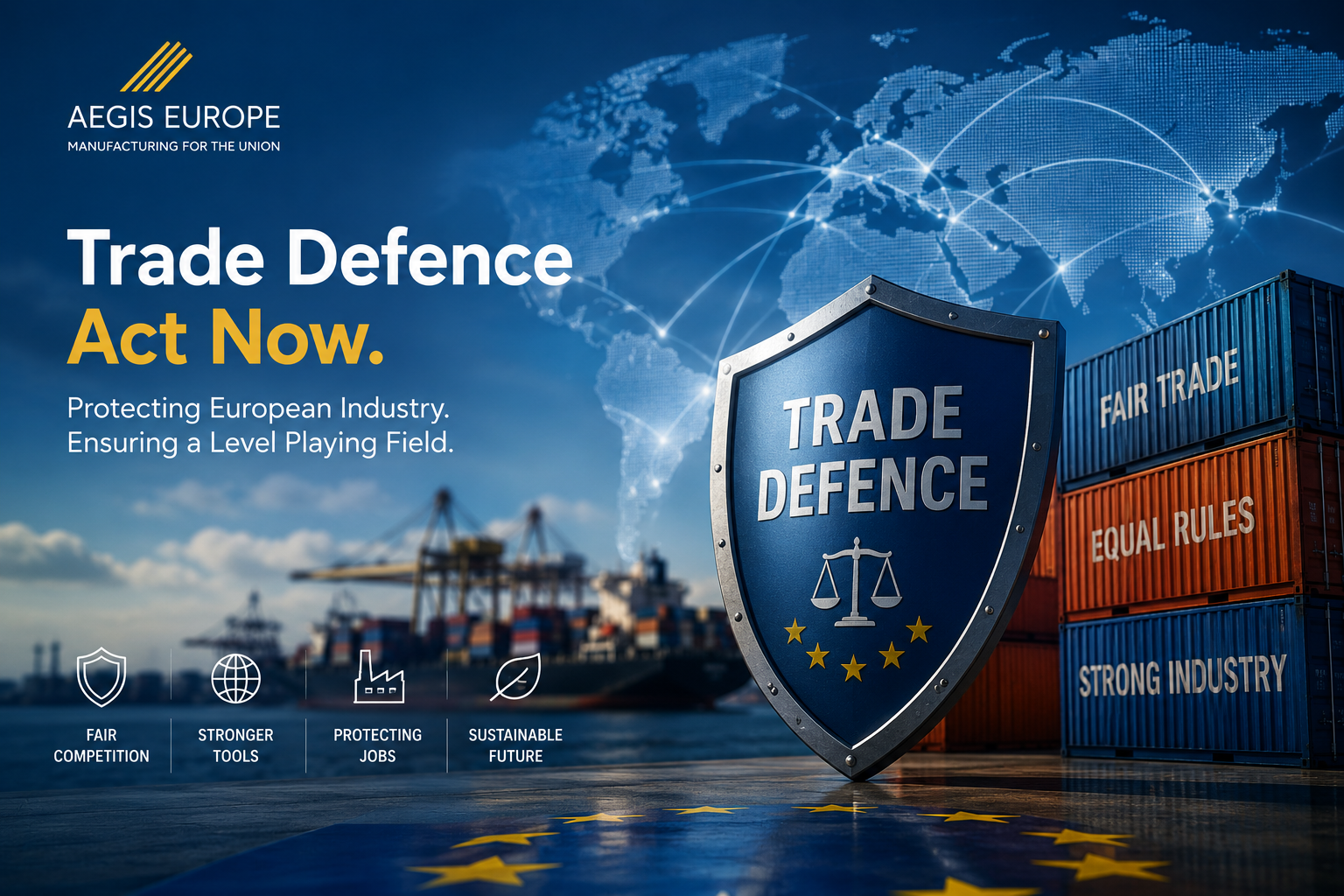
The EU needs action on Trade Defence now
AEGIS Europe warns that European manufacturing is facing growing pressure from unfair trade practices, global overcapacities, and imports that fail to respect EU environmental and social standards. The paper calls for stronger and faster EU trade defence measures, including reinforced anti-circumvention rules, broader investigations across entire value chains, and new tools to address market distortions and industrial overcapacity. It provides recommendations based on changes to the current practice and changes to the law.
The EU needs action on Trade Defence now
European manufacturing is under extreme pressure from unfairly traded imports: state-controlled and export-driven economies, overcapacities in many sectors and in many countries, as well as imports that disregard EU environmental and social standards, create an uneven playing field, leaving European industries at a disadvantage.
The Draghi Report has highlighted the urgent need for a resilient and competitive European industry that aligns with Europe’s strategic interests1. The Report highlighted the gaps in the EU’s current trade defence mechanisms that need to be addressed. We need flesh on the Draghi bones.
In recent strategy papers, the European Commission seems to have recognised the need for a more effective trade defence toolbox, but it has not backed up these easy statements with effective action. In the meantime, world class, efficient and innovative EU industries are dying. AEGIS Europe has been calling for more action for many years.
In this paper we set out some of the actions needed.
Changes to current practice
Allocation of additional human resources: There must be the immediate allocation of additional human resources to DG Trade. This will allow for more investigations into unfair practices, more time to understand and address changes in state-run trade strategies, more creative use of current instruments and to make proposals for legislative change.
A value chain approach: Investigations encompassing a whole supply chain: The Commission must initiate one or more simultaneous investigations covering the full value chain to address similar unfair trading practices at all levels of a value chain.
Duties on downstream products incorporating upstream products: Duties on incorporated products: the Commission must impose, as they do in the USA, measures not only on the upstream product itself but also on that part of the downstream product that is made up of the upstream product. This can be done by drafting the NOI sufficiently broadly.
Social and Environmental Costs in dumping calculations: Social and environmental costs are factored, by law, into the injury calculations. To avoid an unfair comparison between the dumping and the injury, they must be factored into the calculation of the dumping margin.
Better SMEs Support: The Commission must establish an office, not only to explain TDI but to actually assist sectors, dominated by Small and Medium Enterprises, in the filing of complaints and in the completion of the injury questionnaire.
Better monitoring of trade patterns: The Commission must improve the trade monitoring system with the obligation to advise industry and build cooperation with industry on ex-officio investigations.
More robust use of circumvention rules to address new forms of circumvention practices: Third-country exporting producers hit by trade defence measures, or the imposition of unilateral tariffs, are becoming more and more skilled and innovative to immediately circumvent the duties in place. Boosted by domestic subsidies, third-country exporting producers subject to duties, are engaging in “duty offshoring” practices, which consist in establishing a production presence, whether partial (through finishing operations) or total (through production) outside their home country (in the EU or outside the EU), in order to bypass a duty (tariff, anti dumping duty).
Duty offshoring practice is a practice for which there is insufficient due cause or economic justification other than the imposition of the duty, and for which there is evidence of dumping and injury and evidence that the remedial effects of the duty are being undermined in terms of the prices and/or quantities.
Third-country exporting producers subject to duties are also circumventing duties by adding an additional processing step to their products initially subject to duties to avoid the measures and export downstream products. This results in displacing the issue of unfair trading practices from Chinese exporters in the value chain, from upstream producers to downstream producers, equally affected by these systemic unfair trading practices.
When there is a change in the pattern of trade which consists in an increase of imports of a product immediately derived from products subject to anti-dumping duties and belonging to the same value chain, the Commission should qualify this practice as a new form of circumvention practices falling under Article 13(1) of the Basic Anti-Dumping Regulation.
More extensive use of particular market situation: Increasingly, an input from one country (often China) is exported at dumped or distorted prices into a second country (often another Asian country), which then exports a finished product to the EU at injurious prices. This is sometimes referred to as “input dumping”. The Commission should be more robust in finding a particular market situation (to adjust the distorted input from the first country) in such scenarios to enable the EU industry to have an effective remedy.
Changes to the law
Improvement of the safeguard instrument: Reform the voting system in safeguards procedures: the current rule of a qualified majority voting only adds another obstacle to a procedure which already asks the concerned industries to meet very strict conditions. As done for the anti-dumping instrument, the voting rule should change in blocking a proposal from the Commission only if a qualified majority votes against the Commission’s proposal. Allowing the EU industry to file a safeguard complaint would also streamline the procedures – rather than having to provide the data via Member States.
Removal of the Lesser Duty Rule: In cases where the dumping margin is higher than the injury margin, and only in these cases, the simplest and most straightforward solution is to remove the need to make a comparison between the dumping margin and the injury margin. In other words, to remove the lesser duty rule. The lesser duty rule is not required by WTO law. It is a WTO + provision of EU law. There is nothing to prevent the Union from removing this requirement. The removal of the lesser duty rule must become the priority for EU policy makers, therefore, AEGIS Europe supports the reference to this important change in the Steel and Metals Action Plan. The lesser duty rule should be automatically not applied where there is evidence on the file of significant overcapacities in the countries of origin of the dumping.
A new instrument to deal with overcapacities: The Commission is proposing an overcapacities instrument for steel. The EU needs a similar instrument for other sectors: The instrument must allow for the imposition of punitive tariffs, or any equivalent measure, at the border, on goods sourced in third countries which have given support directly or indirectly to the rise of economically irrational overcapacities.
This instrument: i) must be available independent of the Safeguard instrument; ii) must result in measures made effective at the EU border; and iii) must be triggered by the EU industry (and not a Member State) to give the initiative to industry.

AEGIS Europe reacts to the European Parliament endorsement of the European Commission proposal for simplifying the CBAM
Brussels, 23 May 2025. Yesterday, the European Parliament endorsed the European Commission’s proposal to simplify the Carbon Border Adjustment Mechanism (CBAM). The text was adopted with 564 votes in favour, 20 against, and 12 abstentions, reflecting broad political consensus. MEPs introduced only technical amendments for clarification and supported the inclusion of a new de minimis mass threshold of 50 tonnes.
We welcome the remarks made by MEP Antonio Decaro, Chair of the ENVI Committee and rapporteur, following the vote:
“The CBAM is a crucial instrument to help the EU prevent carbon leakage and incentivise climate action outside the EU. (...) This approach enables us to simplify matters for companies without dismantling or weakening the CBAM. We will continue to work quickly to bring legal clarity and certainty to all CBAM stakeholders.”
While we support this progress, we urge legislators to consider some key recommendations to ensure that the CBAM remains both effective and industry-friendly:
AEGIS Europe has been advocating for the adoption of an export adjustment for several years: CBAM needs a WTO-compatible export solution for CBAM sectors to avoid carbon leakage and the replacement of EU low-carbon products with high-carbon alternatives on global markets, in a context where European producers already face several challenges in the export market, including high production costs (especially energy costs), global overcapacities, and aggressive industrial and trade policies by third country competitors.
Furthermore, anti-circumvention rules must be strengthened to ensure the effectiveness of the measure and avoid practices such as resource shuffling which allows the exporting to the EU only products with lower carbon footprint while deviating other products to other markets, or cost absorption, where producers could absorb partially or totally the cost of the CBAM by reducing the price of the products at the EU border and/or by spreading the levy across his entire production. The risk of circumvention must be monitored at customs level, and the authorisation process for CBAM declarants should ensure that they are sufficiently skilled to detect this. Effective enforcement of the new exemption threshold for small importers at 50 tonnes of CBAM goods per year as introduced by the Omnibus package is necessary to prevent circumvention, as economic operators could try and avoid CBAM obligations by artificially importing through multiple entities falling below the threshold. Moreover, while AEGIS sees the benefits of simplifying CBAM for importers, it draws the legislator’s - attention to the need to reciprocally simplify the EU ETS for small emitters on the EU manufacturing side.
AEGIS Europe supports a CBAM that is efficient in addressing carbon leakage risks while ensuring a level playing field on both European and foreign. To achieve these goals, we believe it is imperative to assess CBAM effectiveness before any extension of its scope: this assessment should have as a departing point a consultation of the industry. To do so, it is important to define the assessment criteria which will be used and to conduct a prior thorough impact assessment by consulting the industries concerned. Moreover, for some ETS sectors with very specific value chains, products, and global trade flows, a CBAM cannot effectively address carbon leakage and reduce emissions. For these sectors a stronger carbon leakage protection is needed.
In conclusion, AEGIS Europe members agree on the ultimate importance of finding a balance between simplification, accuracy and effectiveness of the mechanism in preventing carbon leakage. Moreover, simplification should not facilitate or lead to circumvention, and any effort in this sense should be subject to a comprehensive evaluation. A thorough consultation of the industry, including both CBAM sectors and sectors which might be covered by CBAM, should be conducted, keeping in mind that CBAM alone cannot solve the carbon leakage issue for all sectors, and further measures are needed to achieve decarbonisation.
***
AEGIS Europe is an industry alliance that brings together more than 25 European manufacturing associations representative of the whole value chain, from commodities down to consumer end products. Our Members account for more than €500 billion in annual turnover, as well as for millions of jobs across the EU.
AEGIS Europe reacts on the ERCST Report “Solutions for exports of EU CBAM-covered goods”
AEGIS Europe reacts on the ERCST Report “Solutions for exports of EU CBAM-covered goods”and asks for an effective export solution, strengthened anti-circumvention measures and thorough industry consultation
Bruxelles, 8 May 2025. AEGIS Europe welcomes the recent publication of the ERCST Report “Solutions for exports of EU CBAM-covered goods” on March 25th. The report provides an in-depth analysis of the main proposals to address exports related carbon leakage that were advanced over the years, and we are glad that AEGIS Europe’s legal study for a WTO-compatible export adjustment has been included in the analysis.
AEGIS Europe has been advocating for the adoption of an export adjustment for several years: CBAM needs a WTO-compatible export solution for CBAM sectors to avoid carbon leakage and the replacement of EU low-carbon products with high-carbon alternatives on global markets, in a context where European producers already face several challenges in the export market, including high production costs (especially energy costs), global overcapacities, and aggressive industrial and trade policies by third-country competitors.
Furthermore, anti-circumvention rules must be strengthened to ensure the effectiveness of the measure and avoid practices such as resource shuffling which allows the exporting to the EU only products with lower carbon footprint while deviating other products to other markets, or cost absorption, where producers could absorb partially or totally the cost of the CBAM by reducing the price of the products at the EU border and/or by spreading the levy across his entire production. The risk of circumvention must be monitored at customs level, and the authorisation process for CBAM declarants should ensure that they are sufficiently skilled to detect this. Effective enforcement of the new exemption threshold for small importers at 50 tonnes of CBAM goods per year as introduced by the Omnibus package is necessary to prevent circumvention, as economic operators could try and avoid CBAM obligations by artificially importing through multiple entities falling below the threshold.
AEGIS Europe supports a CBAM that is efficient in addressing carbon leakage risks while ensuring a level playing field on both European and foreign. To achieve these goals, we believe it is imperative to assess CBAM effectiveness before any extension of its scope to downstream products: this assessment should have as a departing point a consultation of the industry. To do so, it is important to define the assessment criteria which will be used and to conduct a prior thorough impact assessment by consulting the industries concerned. Moreover, for some ETS sectors with very specific value chains, products, and global trade flows, a CBAM cannot effectively address carbon leakage and reduce emissions. For these sectors a stronger carbon leakage protection is needed.
Finally, AEGIS Europe members agree on the ultimate importance of finding a balance between simplification, accuracy and effectiveness of the mechanism in preventing carbon leakage. Moreover, simplification should not facilitate or lead to circumvention, and any effort in this sense should be subject to a comprehensive evaluation. A thorough consultation of the industry, including both CBAM sectors and sectors which might be covered by CBAM, should be conducted, keeping in mind that CBAM alone cannot solve the carbon leakage issue for all sectors, and further measures are needed to achieve decarbonisation.
AEGIS Europe is an industry alliance that brings together more than 25 European manufacturing associations representative of the whole value chain, from commodities down to consumer end products. Our Members account for more than €500 billion in annual turnover, as well as for millions of jobs across the EU.